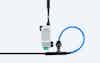
Low-Frequency Bearing Current Monitoring with Rogowski Current Sensors

About Low-Frequency Bearing Currents
Low-frequency bearing currents can occur in large rotating electrical machines when shaft voltages are produced by magnetic asymmetry, grounding conditions or other machine-specific current paths. In particular, asymmetry in the machine’s magnetic circuit can induce an AC shaft voltage at the electrical fundamental frequency and its harmonics, which can drive circulating current through the shaft, bearings and machine structure when a closed conductive path exists.
Repeated current flow through the bearings can contribute to electrical erosion, pitting and fluting of the bearing surfaces, potentially reducing bearing life. The magnitude and waveform depend on factors including machine construction, magnetic asymmetry, shaft voltage, grounding arrangement, bearing configuration and operating conditions.
Measuring low-frequency bearing current therefore requires a measurement system with sufficient sensitivity and low-frequency response to resolve the power-frequency fundamental and associated harmonic components. Depending on the application, measurements may be made for permanent condition monitoring or for diagnostic investigation, with changes in current magnitude and harmonic content providing useful information about bearing-current behaviour and the associated current paths within the machine.
PEM’s RCTi/25 & LFR/015/1.5


PEM has developed a specialised sensor to address this exact challenge. Drawing on decades of Rogowski current measurement expertise, our RCTi/25 (permanent monitoring) and LFR/015/1.5 (diagnostics) Rogowski current sensors are specifically engineered to detect and measure low-frequency bearing currents.
These Rogowski sensors address the unique requirements of this application:
- Customised frequency response from 4 Hz to 40 kHz, optimised to maximise SNR at power frequencies to >50th harmonic.
- High sensitivity (200 mV/A) for detecting even low-magnitude damaging currents.
- Air-core design that eliminates the magnetic saturation issues.
- Customisable dimensions adaptable to any shaft size.
- Flexible installation options with cable lengths from 2.5m to 30m for complex environments.


Key Features
- Optimised bandwidth for best SNR:
- 0.6Hz to 1MHz (RCTi/25) (coil length dependent)
- 4 Hz – 40 kHz (LFR/015/1.5)
- High sensitivity and low noise:
- 200 mV/A
- Current range:
- up to 25A rms (RCTi/25)
- 30A pk (LFR/015/1.5)
- Flexible coil circumference (500–7000 mm) for large shafts. Longer coils possible.
- Long cable lengths available (2.5–30 m) for installation flexibility.
- Electronics to suit your needs: The RCTi in either a DIN rail case or robust, EMI immune panel mount enclosure for permanent installation, or the LFR battery powered electronics for troubleshooting applications and simple connection to a scope or datacorder.
Why PEM?
Technical Leadership
Our purpose-designed measurement technology is optimised for the specific challenges of low-frequency phenomena, delivering superior sensitivity and accuracy at power frequencies where conventional solutions fail.
Application Experience
With proven installations in critical infrastructure globally, we combine detailed understanding of bearing current mechanisms with the Rogowski design to every project. Our solutions have been deployed in the most challenging environments worldwide.
Customisation Capability
We offer bespoke sensor designs for unique requirements, flexible form factors for complex installations, and tailored sensitivity specifications to match your exact needs.
Talk to Us
Every electrical machine application is different. Whether you’re designing new systems, troubleshooting bearing failures, or implementing preventive maintenance programmes, PEM can help you build the right current sensing solution.
This application relates to the following products: